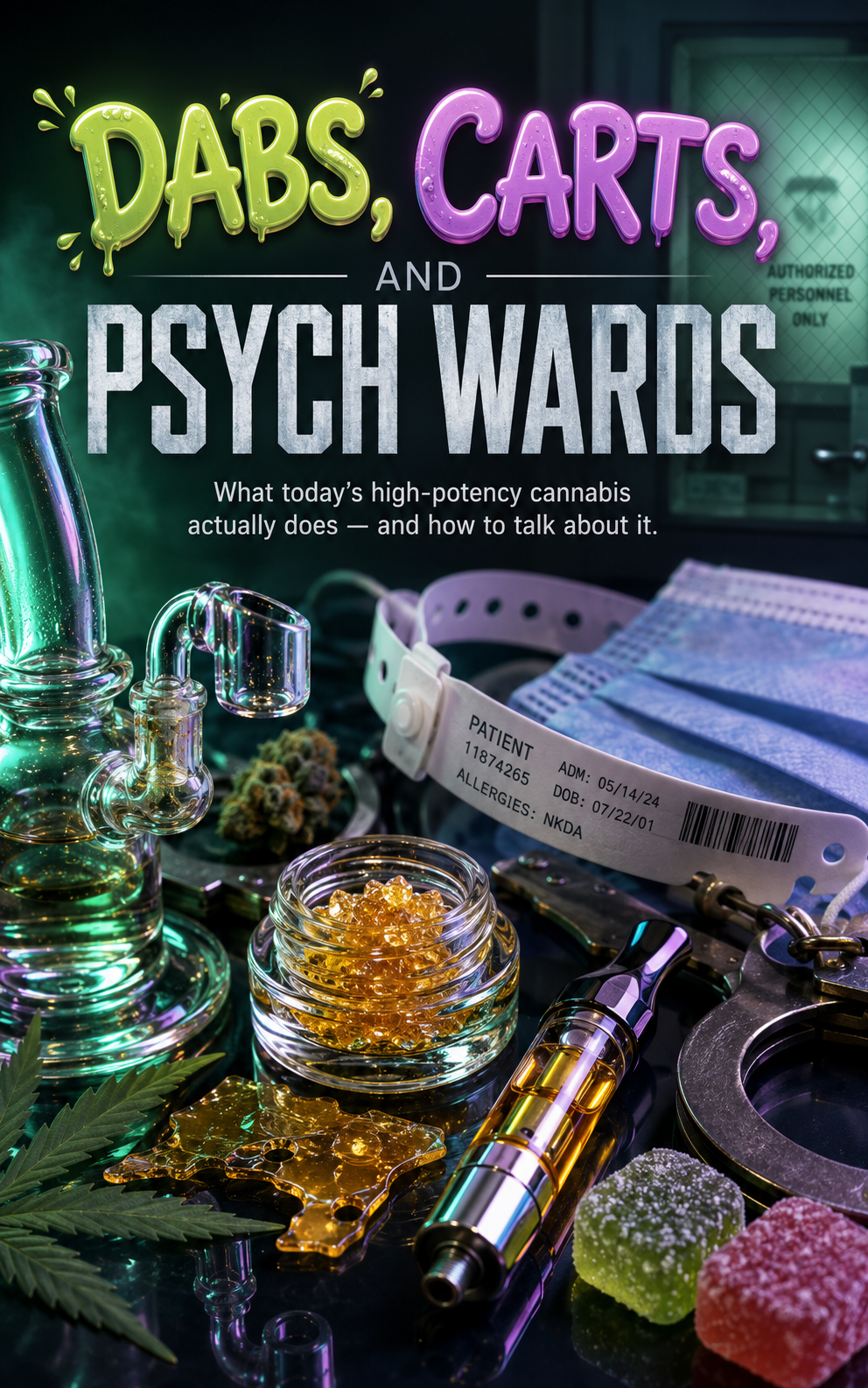
The marijuana of 1975 was about 1% THC. The concentrate sold today runs to 90% THC. That's not stronger weed: that's a different drug, and the evidence now ties it to psychosis and lasting mental illness. Let's look at: what that drug does, who profits from it, and how to slow down the death march to the psychiatric ward.
Free to reproduce, print, and share. It belongs to no one. Copy it, post it, print it, hand it to whoever needs it.
Preface
You've Been Lied to About Weed
Sold as harmless. It isn't, and you've probably already seen why.
You already know how this can go for somebody. The friend who got deep into dabs or carts and slowly drifted somewhere you couldn't follow: paranoid, flat, sure of things that weren't real, gone quiet in a back bedroom. Maybe they came back. Maybe they didn't. Anyone who spends real time around heavy weed has watched some version of it, and has had the same quiet thought: not me.
That wasn't bad luck or a weak mind. It was the drug, and specifically how strong the drug got while nobody was paying attention. This is about what today's weed actually does to some of the people who use it, and why the ones it hits hardest are young.
You've got a good instinct for sniffing out a scare on this subject, and you'll want it here, so this won't preach and it won't exaggerate. It's short, about twenty minutes, and every number links straight to its source, so you don't have to trust me; you can check. The honest facts are unsettling enough without any help.
One thing worth knowing going in: almost everything you've absorbed about weed being basically fine came from people with something to sell. A legal industry spent a fortune making sure you'd never stop to ask what the strong stuff does. That's the story this checks. It's for people who use, people thinking about starting, and the people who love them.
Read it, then make up your own mind — with the actual evidence in front of you, instead of whichever version someone with a sales target picked for you.
Chapter 1
Not Your Father's Weed
The name never changed. The drug did — and its gentle reputation is decades out of date.
The most important fact about cannabis is also the one almost nobody says out loud: the drug your uncle smoked at a concert in 1975 is not the drug being sold today.
When the federal government's own potency monitoring program began testing confiscated cannabis in the 1970s, the average sample contained well under two percent THC, the compound that produces the high and, as we will see, the harm. By the mid-1990s it had crept up to roughly four percent. By the late 2010s the average seized flower had climbed past fifteen percent, and the flower on a dispensary shelf today is often stronger still.
But flower is no longer the point. The product that built the modern industry is the concentrate (the “dabs,” “shatter,” “diamonds,” “live rosin,” and the vape cartridge you already know by name), and concentrates routinely test at sixty to ninety percent THC and above. Someone drawing on a cart today is not having their grandfather's experience turned up a notch. They are using a substance that, by potency, stands in roughly the same relation to 1970s marijuana as a tumbler of grain alcohol stands to a glass of beer.
The same word, a different drug
Average THC content: what “marijuana” has meant, decade by decade
~1%
1975 flower
~4%
1995 flower
~17%
2017 flower
~85%
Today's concentrate
Flower potency from the NIDA / University of Mississippi Potency Monitoring Program (~1% in the 1970s, 3.96% in 1995, 17.1% in 2017); concentrate figures from state cannabis-testing data. The last bar is not stronger weed. It is a different drug.
This is not a quibble about strength. It is the whole story. Because nearly all of the reassuring research that the public still half-remembers (the studies that found cannabis to be relatively benign) was conducted on a drug that no longer exists in the marketplace. We legalized one thing and commercialized another, and we are measuring the damage of the second with the comfort we took from the first.
And now it is everywhere
Since 2012, when the first states legalized recreational cannabis, the country has run an enormous, uncontrolled experiment on itself: it made the drug both far stronger and far easier to get at the same time. You can watch several things move together.
Emergency departments. In legalizing states, cannabis-related ER visits rose, for acute intoxication, for cannabis-induced psychotic episodes, and for a condition most people have never heard of: cannabinoid hyperemesis syndrome, cyclical, violent vomiting in heavy chronic users, a syndrome not even described in the medical literature until 2004. It is exactly what you would expect from a much stronger drug used much more often.
Children. Calls to poison control for young children who ate cannabis edibles (gummies and candies indistinguishable from ordinary candy) rose more than fourteenfold in four years, from 207 cases in 2017 to 3,054 in 2021, per national poison-control data published in Pediatrics in 2023. That is not a statistical subtlety. It is toddlers in the ER, because the industry built its product to look like a fruit snack and stocked it at a child's eye level.
Toddlers in the ER
Young children (under 6) treated for eating cannabis edibles, reported to U.S. poison control
207
2017
3,054
2021
A fourteenfold rise in four years (+1,375%). Source: Pediatrics (2023), national poison-control data.
Use itself. Daily and near-daily cannabis use in the United States has climbed so far that in 2022 it passed daily drinking for the first time: an estimated 17.7 million Americans reported using cannabis every day or nearly every day, against 14.7 million daily or near-daily drinkers (a 2024 analysis of federal survey data by Carnegie Mellon's Jonathan Caulkins).
Correlation, honestly
Many things changed after 2012, and reporting improved, so a rising tide of ER visits is not by itself proof of anything. Hold that thought. The point of this chapter is only the setup: we multiplied the strength of the drug severalfold, stripped away nearly every barrier to getting it, and pointed the marketing at the young. The next three chapters are about what that combination does to a mind, where the careful, individual-level evidence lives.
So that is the first half of the title, in one sentence: dabs and carts, many times stronger than anything the word “weed” used to mean, sold on nearly every corner and built to be used every day. Keep the potency number in mind (sixty to ninety percent) because in the next chapter it stops being a fact about chemistry and becomes a fact about the brain.
It has happened before, to a civilization far older and prouder than ours. The difference is who did it to whom.
If you want to know what happens to a nation that lets a drug saturate its people for profit, you do not have to guess. You can read it. It is one of the best-documented catastrophes in modern history, and it has a body count measured in a century.
At the start of the nineteenth century, Britain had a problem that was, of all things, about tea. Britain wanted China's tea, silk, and porcelain (wanted them desperately) but China wanted almost nothing Britain made in return, and would sell only for silver. So British silver drained eastward, year after year, and the men who ran the British East India Company went looking for something, anything, the Chinese would buy.
They found it. They grew opium in India and smuggled it into China in defiance of Chinese law. It worked beyond their hopes. The drug was addictive, the market was vast, and within a generation an estimated four to twelve million Chinese were habitual users. The silver reversed course and flooded back to Britain. A trade deficit had been solved by hooking a nation.
When China tried to stop it
In 1839 the Chinese emperor sent a man named Lin Zexu to Canton to end the trade. Lin was, by every account, an official of formidable integrity, the kind of public servant who is rare in any century. He moved fast. He confiscated the foreign merchants' opium and destroyed it: more than twenty thousand chests, roughly 1,400 tons of the drug, broken down and washed into the sea. He wrote a famous open letter to Queen Victoria asking, in effect, how a Christian nation could do to others what it would never permit at home.
Britain's answer was the navy. The drug trade was too profitable to surrender, so when China moved to stop it, Britain went to war to keep it flowing: the First Opium War, and then, when the terms were not punishing enough, a second. The wars were less battles than demonstrations: modern gunboats against a society that had been, in part, hollowed out. The Treaty of Nanking in 1842 ceded Hong Kong to Britain, forced open the ports, and extracted a crushing indemnity. Historians in China still call what followed the Century of Humiliation — the long subjugation of the oldest continuous civilization on earth, set in motion by a flower.
The two lessonsOne: a nation saturated with a profitable, addictive drug becomes weak and dominable, so weak that full invasion is unnecessary; coercion against a hollowed-out society does the work. Two: those who profit from the drug will fight, with everything they have, the people who try to stop it. Lin Zexu did the right thing and got a war for it.
The difference that should bother us
Now hold the Chinese story up against our own, and feel where it bites.
China had opium forced on it. An empire wanted the trade and sent cannons to protect it; the Chinese government, to its credit, tried to throw the drug out and was beaten for the attempt. There is a villain in that story, and he sails under a foreign flag.
We have no such excuse. We did it to ourselves. No foreign navy forced high-potency THC into American towns. We legalized it, taxed it, franchised it, and put it on a billboard. We held elections and voted it in. The closest thing we have to Lin Zexu, the physicians and researchers who keep raising their hands to say this is hurting our young people, are not overruled by gunboats. They are overruled by lobbyists, by tax-revenue projections, and by a culture that decided the question was settled before it looked at the evidence.
That is the line to carry out of this chapter: when China tried to stop the drug, the dealers sent gunboats; when our doctors try to warn us, the industry sends lobbyists. Same dynamic, softer weapons, and this time the saturated nation did the saturating to itself.
Who's behind it?
Maybe you wonder whether someone is steering this from the outside. Fair, and I am not going to talk you out of asking: the institutions that would tell you otherwise have earned every bit of the distrust your generation carries. But here is the part that is darker than any foreign plot: nobody had to force this on us. We legalized it, taxed it, franchised it, and bought it ourselves, by the cartridge, on the corner. Who profits is worth asking. What it is doing to you is worth asking more.
We will return to the Opium Precedent near the end, in a chapter about armies and the young men who fill them, because the question Lin Zexu's emperor faced is, in a quieter form, our own. What becomes of a country whose young men are pacified by a drug its own laws now protect?
Chapter 3
What Pot Actually Does
Here is the strongest, most recent, peer-reviewed evidence, handled carefully, because the case does not need to be exaggerated.
The last chapter left off with a number: sixty to ninety percent. This chapter is about what that number does to a developing brain. It will be careful with the evidence, because overstatement is exactly how good arguments get thrown out, and because the honest version is alarming enough.
Psychosis
The largest study of its kind, the EU-GEI study, published in The Lancet Psychiatry in 2019, compared people experiencing a first episode of psychosis with healthy controls across eleven sites in Europe and Brazil. Daily cannabis users had roughly three times the odds of a psychotic disorder compared with people who had never used. Daily users of high-potency cannabis (defined there as 10% THC or more) had nearly five times the odds. The researchers estimated that if high-potency cannabis were removed, about one in eight first-episode psychosis cases across the eleven sites would not occur, rising to roughly a third in London and about half in Amsterdam.
Now read that ten-percent threshold against the chart from Chapter 1. The “high-potency” cannabis that produced a nearly fivefold jump in psychosis risk was defined at just ten percent THC, weaker than the average flower on a dispensary shelf today, and a small fraction of the sixty-to-ninety-percent concentrates that now dominate the market. That study did not measure today's drug. It measured something far milder, and the result was already alarming. Given how steadily the risk climbs with the dose, the honest expectation is that today's products are more dangerous than those figures, not less. The numbers on this page are very likely a floor.
It does not always end when the high does. A Danish study published in the American Journal of Psychiatry in 2018 followed people who had been treated for a cannabis-induced psychosis, the kind that is supposed to be temporary, a bad trip that clears. It did not clear for everyone. Roughly 47 percent went on to develop a lasting schizophrenia-spectrum or bipolar disorder. That is the highest conversion rate of any substance-induced psychosis studied.
The harm that doesn't healEven the drugs we consider most destructive share a kind of mercy this one does not always grant. Stop drinking, and the body does much of its healing; get clean from cocaine, and the mind, over time, largely comes back: the damage was mostly in the using. Cannabis carries a rarer and crueler risk: it can trip a switch that does not switch back. In roughly half of the cases where its use triggers a psychosis, that psychosis hardens into lifelong schizophrenia or bipolar disorder. The drug itself leaves the body in weeks. The illness it can start — in the young person whose brain is still being built — may never leave at all.
And the drug itself lingers long after the last use. THC is fat-soluble. In a daily user it builds up in body fat faster than the body can clear it, forming a reservoir that seeps back into the bloodstream for weeks: its breakdown products stay detectable in heavy users for a month or more after they quit. Because that store sits in fat, anything that burns fat (a diet, real stress, hard exercise) can push stored THC back into the blood, an effect researchers have literally named reintoxication. This is a plainer, physical mechanism, and it points the same way: with this drug, quitting is not the same as being clear of it.
The signal is showing up at the level of whole populations. As cannabis grew more potent and more available, Danish national-registry research has tracked a steadily rising share of schizophrenia cases statistically attributable to cannabis use disorder (Hjorthøj, JAMA Psychiatry, 2021; strongest in young men, Psychological Medicine, 2023). The association is strongest, by a wide margin, in young men. That attributable share rose roughly fourfold (from about 2% before 1995 to 6–8% after 2010) and the most recent analysis puts it near 15% among men overall, and higher still, by some estimates as much as 20 to 30%, in the young-male age bands where the drug hits hardest.
Why young men
This is not bad luck or moralizing; it is neurology. The human brain is not finished until the mid-twenties, and the prefrontal cortex (the seat of judgment, impulse control, and planning) is the last region to mature. The brain's own cannabinoid system is deeply involved in that wiring. Saturating a still-developing brain with high-potency THC, daily, during exactly the years it is laying down its adult architecture, is a reckless thing to do on its face; the data are now catching up to confirm it. The group most drawn to heavy, high-potency use (adolescent and young-adult males) is the same group whose brains are most exposed. The bullseye and the dartboard are the same people. None of this means a young woman is safe. The same risk is real for her, only lower, and it belongs to the young of both sexes even as it falls hardest on young men.
People predisposed to psychosis may be drawn to cannabis; the arrow can point both ways. But the case for cannabis as a genuine cause (not merely a companion) is unusually strong: the relationship is dose-dependent (more, and stronger, means worse), it is biologically plausible (we know what THC does to the developing brain), it holds across different countries and methods, and it shows up in whole-population data, not just in clinics. That is roughly the same architecture of evidence that, decades ago, finally convicted tobacco. We did not need a confession from a cigarette to know what it was doing.
Now widen the lens from the diagnosis to the person, because the young American man is in more trouble than the country has let itself notice. Across a dozen data sets that rarely get laid on the same table, young men are falling behind: behind young women in school and college completion, working less, living with their parents longer, partnering and marrying later or not at all. They report fewer close friends than any cohort on record. They spend extraordinary hours alone, with screens. Into that fragile picture we introduced a cheap, ubiquitous, high-potency drug that the best evidence says corrodes exactly the faculties (mood, motivation, contact with reality) that were already failing.
Accelerant, not sole cause
High-potency cannabis is not the single cause of the crisis in young men. It plainly is not; the loneliness, the lost role, the screens, the vanished rites of passage were all there first. The claim here is narrower and, honestly, hard to dispute: into a generation already stumbling, we poured an accelerant the science ties to psychosis and lasting mental illness, and aimed it squarely at the age when the brain can least afford it. You do not have to call it the arsonist to call it a catastrophe.
Catastrophes are supposed to be loud. This one is the opposite, which is exactly why it has been so easy to ignore. It does not look like a disaster. It looks like a young person who is “just kind of stalled.” Who games and dabs in a darkened room. Who was going to go back to school. Who got a little paranoid that one time but seems fine now. Who is, their family insists, simply “finding themselves,” right up until the afternoon they aren't: the first episode, the hospital, the psych ward in the title. Multiply that quiet shape by a generation and you have a slow-motion emergency with no single moment a camera can capture. There is just a steady, distributed loss of young men — to the ward, to the couch, to the grave — that we have declined to add up, because the adding-up implicates a product we decided to like.
Accessible overview: Yale School of Medicine, “Behind the Smoke” (2024).
Adolescent neurodevelopment and cannabinoid vulnerability: reviews in PMC (Meyer, Lee & Gee; Casadio et al.). Fat storage and “reintoxication”: Gunasekaran et al., British Journal of Pharmacology (2009).
The cohort: college-enrollment gap (NCES); young men living with parents, prime-age male labor-force participation (U.S. Census; Pew; BLS); the “friendship recession” (Survey Center on American Life, 2021).
Chapter 4
It's Just a Plant, and Other Lies
Five things people say to end the conversation, and why not one of them is an argument.
Nobody defends a daily habit with silence. There is always a line, delivered as though it settles the matter, and if you use (or love someone who does) you have heard all five of these. They feel like reasons. They are not. Each one is a way of refusing to ask the only questions that actually matter, which we will get to at the end.
“It's just a plant.”
This is one of the oldest errors there is, and it even has a name: the appeal to nature. The unspoken move is that natural equals safe: that what grows from the ground cannot really hurt you. It collapses the instant you look at it.
Nature is full of plants that will kill you. Belladonna (deadly nightshade) is a plant. Hemlock, which killed Socrates, is a plant. Foxglove, oleander, the castor bean that gives us ricin, tobacco that gives us a third of all cancer deaths — all plants, all natural, all as God-made as any other. And so is the opium poppy, the flower that hollowed out a nation and brought an empire's gunboats down on China. The drug that humbled the largest civilization on earth was just a plant.
The principle that disposes of all of it is five hundred years old. The physician Paracelsus put it in the sixteenth century: the dose makes the poison. There is no substance so benign that enough of it will not harm you: people have died drinking too much water; children and adults alike have died of acute salt poisoning. A ninety-percent concentrate, vaporized daily into the brain of a nineteen-year-old, is not absolved by the fact that the THC inside it can be traced to a leaf.
“It's legal now, so it's safe.”
Legal means taxed. It has never meant safe. Tobacco was legal the entire time it was killing a third of the people who used it exactly as directed. Alcohol is legal and buries tens of thousands a year. Opium was legal (moved by a company with a royal charter and a spotless reputation) while it addicted millions. “Legal” is a decision a legislature made about revenue and enforcement. It is not a finding about your brain. The two are barely related.
“Weed's not addictive.”
About three in ten people who use cannabis develop cannabis use disorder, the clinical term for the thing everyone insists can't happen to them: wanting to cut down and not managing it, needing more for the same effect, arranging the day around it. The risk is higher the younger you start and the stronger the product, which describes the modern market exactly. “I could stop any time” is not evidence that you could. It is usually the first thing that stops being true.
“The gateway thing was debunked.”
You were told for decades that marijuana was a “gateway drug,” then told the gateway was a myth, and you are right to be wary of being sold a third thing. So here is the precise version: the crude claim (that a puff mechanically leads to heroin) was always too crude. The real, better-supported concern is narrower: heavy, early, high-potency use is tied to worse mental-health trajectories and other substance problems down the line, especially in the young. But the drug does not need a “next” drug to do its damage. That is the part the old debate missed. It can derail a developing life entirely on its own. The first one is enough.
And notice where that derailment actually leads. The old gateway was supposed to end at a back-alley drug; the real one more often ends at a pharmacy counter. The heavy user who tips into psychosis, paranoia, or bipolar doesn't graduate to heroin. They graduate to a diagnosis, and to the antipsychotics and mood stabilizers that can come with it, sometimes for the rest of their life. Those medicines are often what hold the illness at bay, which is the quiet cruelty of it: even the good ending, the one where treatment works, can leave someone a quieter, dimmer, more medicated version of who they were going to be. That is the gateway worth fearing. Not the one to a harder high, but the one to a lifetime spent managing a mind that turned on them.
“It's safer than what the dealer sold.”
The industry built a product stronger than anything the cartel ever moved. The dealer in 1990 had four-percent flower; the dispensary has ninety-percent concentrate, a storefront, and a loyalty app. A thing cannot be “the safe alternative” to the very product it made obsolete by being worse than it. And “safer than alcohol” is not the claim it sounds like either: alcohol does not, in one in eight cases, help touch off a lifelong psychosis in the young. Different drugs, different harms; “at least it's not X” is not a clean bill of health.
The only questions that matter
Notice what every one of these five lines does: it ends the conversation before it starts. “Natural,” “legal,” “not addictive,” “debunked,” “safer than”: each is a door slammed on the actual inquiry. The real questions are the ones Paracelsus was pointing at, and they are not hard to ask: How much? How strong? How often? And to whom? A little, weak, occasionally, in a grown adult is one thing. A lot, at ninety percent, every day, in a brain that is still being built (which is the modern market's core customer) is another thing entirely. Everything here lives in the gap between those two answers.
Tobacco mortality (~1 in 2 long-term users; a third of cancer deaths). U.S. Surgeon General; CDC.
The Opium Wars and the East India Company opium trade (Britannica; see Chapter 2 sources).
Gateway question, current understanding: heavy early high-potency use and later substance/mental-health outcomes. Reviews in PMC; NIDA.
Chapter 5
The Cannabis Lobby
Every consumable that ever harmed Americans at scale had an industry behind it telling them not to worry. This one is no different.
Up to now you have not needed to believe anyone acted in bad faith. The reassurance can be explained by ordinary human wiring: we trust the natural-seeming, we under-rate the slow harm, we would rather not audit a thing we have decided to enjoy. But there is one place where the explanation gets less innocent, and it is the obvious place: follow the money.
There is now a large, well-capitalized cannabis industry in the United States, and like every industry built on a consumable, its interest is simple and relentless: more customers, using more often, paying more, with as few rules as possible. That is not a moral accusation. It is just what a for-profit business is. The question is whether we are letting that interest write the rules — and we are.
The scale is not small. Legal cannabis sold more than $30 billion in the United States in 2024, and the largest operators are now billion-dollar companies in their own right: Curaleaf booked about $1.3 billion in revenue that year, Trulieve about $1.2 billion, and Green Thumb about $1.1 billion. Each of them grows by the same arithmetic: more users, using more, more often.
And yet, for all that revenue, cannabis has been one of the worst businesses on the market to own: the stocks are down roughly 87% from their 2021 peak, a dime on the dollar, and most of the big operators still lose money. That should unsettle you, not reassure you, because sales and daily use kept climbing to records anyway. The stores themselves give the game away. Drive past the dispensaries, count the cars, and the math never closes: they were overbuilt on purpose, on cheap capital raised in the boom, racing to plant flags and hold licenses ahead of any profit. That storefront is not living on its customers. It is living on the money behind it. Customers were never quite the point.
And here is the part worth sitting with. Because the drug is still federally illegal, most dispensaries cannot use an ordinary bank, so they run, to a startling degree, on cash: a multibillion-dollar industry moving paper bags of twenties, largely outside the banking system that keeps an eye on everyone else's money. Make of that what you will. As for what finally lifted the stocks after years of bleeding, it was not a better product. It was Washington, loosening the drug's federal scheduling in late 2025 and, with it, the punishing tax rules that come with selling a banned substance. The payoff in this business is volume and friendly policy, not shareholder returns, which is exactly why the lobbying never stops.
The playbook is not new
We have seen this film before, twice, and the script barely changes. Tobacco spent decades funding doubt, branding cigarettes as sophisticated and even healthful, marketing to the young, and fighting every label and restriction, until the internal documents came out and the reckoning, decades late, finally arrived. Opioids ran a tighter, faster version: a manufacturer reassured doctors the product was barely addictive, pushed volume, captured the regulatory conversation, and left a body count behind a wall of marketing. In both cases the harm was known internally or knowable externally for years while the central message held: relax, it's fine.
The cannabis industry inherited that playbook and improved on it in one crucial way: it wrapped itself in the language of liberation. Tobacco had to invent glamour. Cannabis was handed a ready-made identity (freedom, justice, anti-establishment cool) that made scrutiny feel like oppression. Question the product and you were not raising a health concern; you were a scold, a prohibitionist, a narc. It is a near-perfect shield, and it was largely free.
What the lobby actually buys
Strip away the tie-dye and the mechanics are conventional corporate influence:
Ballot campaigns. Legalization did not bubble up purely from the grassroots; in state after state it was carried by well-funded campaigns, with multi-state operators (the large, vertically integrated cannabis companies) among the interested money. One operator, Trulieve, poured roughly $145 million into Florida's 2024 legalization initiative, more than 90% of that campaign's funding.
Lobbying and giving. The industry now spends on lobbyists and campaign contributions like any other, at the state level especially, where the rules that matter to it are written.
The marketing of strength, and to the young. The product mix tells you who the customer is. Gummies and candies and bright vape hardware are not designed for a sixty-year-old's arthritis. The drift is always toward higher potency and younger appeal, because that is where the heaviest, most loyal, most profitable use lives.
The tell: no potency caps
If you want to know whose interest is steering the rules, ask the simplest possible regulatory question: why is there no meaningful cap on THC potency? We cap blood-alcohol for driving; we don't sell 180-proof liquor as a casual product. Yet in nearly every legal state ninety-percent concentrates sit on shelves with no ceiling at all: only Vermont and Connecticut cap the potency of flower and concentrates, and even those caps face repeal pressure from the industry. A potency cap is the one rule that would most directly reduce harm, and the one the industry most needs to prevent, because potency is the product. The absence of that cap is the lobby's fingerprint.
Why the politics go along
Money is only half of it. The other half is that permitting this pays for the people who make the rules, too. No smoke-filled room required, just ordinary self-interest all pointing one way.
Tax revenue. Legal cannabis is a cash crop for state budgets; adult-use states have collected more than $29 billion in cannabis taxes since 2014, over $4 billion in 2024 alone. Once a state is spending that revenue, the government itself becomes a stakeholder in the industry's growth. You do not regulate hard the thing that is paying for your programs. It is the same trap that hooked the states on cigarette money: once a government funds itself on a product, it quietly needs that product to keep selling, whatever its own health department says about it.
The vote and the tailwind. Legalization has polled well: a solid majority of Americans, and far more among the young. For a generation of politicians, supporting it was free: popular, modern, “the right side of history.” Opposing it carried the scold's penalty. The path of least resistance ran straight to the dispensary.
Industry money, arriving on schedule. And then there is the money from the section above, written to the people who keep the rules loose.
A bipartisan failure
This is not a left problem or a right problem. The left embraced legalization as justice and the youth vote; the right embraced it as freedom, small government, and tax revenue. Both got something they wanted. The one constituency with no lobby, no donor base, and no checkbook was the nineteen-year-old whose developing brain was the actual stake, and so their interest was the one that lost. They cannot contribute to a campaign. The industry can.
Here is what makes this the engine of the whole thing. A consumable funds a permanent industry with a permanent stake in keeping you calm, in keeping “it's just a plant” the conventional wisdom and the potency cap off the table. It is bought to be used: now, and again, and in larger and larger amounts. That is why the dangerous product is the one sold freely on the corner and defended every single day, while the people who would warn you have no budget at all. The next chapter follows the cost of that arrangement all the way out: from one young man to a country's worth of them.
Chapter 6
An Army We Could Not Raise
Zoom out from one young man to a country's worth of them, and the private tragedy becomes a national exposure.
In the 1940s, this country took its eighteen-year-olds (farm boys, factory boys, kids who had never left their hometown) and formed them into the force that won the largest war in human history. They were not saints. That generation had plenty wrong with it, and an honest account would say so. But Tom Brokaw called them the Greatest Generation and the name stuck, because whatever their flaws, they could be called upon. When the country needed a formidable force from its young men, the young men were there to be made into one.
Now ask the uncomfortable question this whole thing has been walking toward. Could we do that today? Could the United States, from the same demographic (eighteen-to-twenty-five-year-old men) raise a force of that scale, fitness, and will? The honest answer is probably not, and the reasons are not only about cannabis. But cannabis is in the middle of them, and it is the part nobody wants to name.
The cruelty of the overlap
Here is the part that should stop you. The demographic that high-potency cannabis harms most (adolescent and young-adult males, the developing brain, the bullseye of Chapter 3) is the exact demographic a nation depends on to defend it. It is not a random slice of the population being hollowed out. It is the slice every society has always asked to stand at the wall.
The military itself has been saying so, with growing alarm. The Pentagon's 2020 Qualified Military Available study found that roughly 77% of Americans aged seventeen to twenty-four are ineligible to serve without a waiver (for obesity, for mental-health conditions, for drug use, for aptitude), leaving only about one in four eligible. The Army then missed its recruiting goal by some 15,000 soldiers in 2022 and fell short again in 2023. Cannabis is not the sole cause of that; it is one strand in a thick rope that includes fitness, education, and the broader malaise of Chapter 3. But it is a strand, and it is a strand we chose, legislated, and franchised. We did not have to put a high-potency intoxicant on every corner aimed at exactly the young men we might one day need. We did it anyway, and called it progress.
Who could serve, then and now (per 100 military-age men)
Green = able to serve. In WWII about 30% of examined draftees were classed 4-F, and total rejections (including noncombat) ran over 40%, even by 1940s standards. Today the Pentagon estimates ~77% of 17–24-year-olds are ineligible without a waiver. The two eras measured fitness differently (an induction physical then, a broad eligibility estimate now), so this is a directional comparison; but the direction is unmistakable, from roughly two-thirds serviceable to under a quarter. Sources: U.S. Selective Service / National Park Service (WWII); DoD Qualified Military Available study, 2020.
The Opium Precedent, come back around
Chapter 2 promised this return. China did not lose the Opium Wars only to better guns; it lost as a society partly hollowed out by a drug those who profited fought to protect. A pacified, debilitated population is a dominable one — that was the whole, terrible lesson. The difference, again, is the one that should keep us up at night: China had its opium forced in by a foreign empire. We are doing the hollowing to ourselves, voluntarily, for tax revenue and a quarterly earnings call. No adversary needed to dope our young men. We built the dispensary and pointed them toward it.
Freedom, and what it actually costs
And so we arrive at the irony this whole thing has been circling. The thing sold to a generation as freedom (weed, liberation, do-what-you-will) is quietly putting that generation in chains: anxious, listless, some of them psychotic, many of them unfit for the ordinary demands of adulthood, let alone the wall. A drug marketed as the ultimate personal liberty turns out, at ninety percent and every day, to be one of the more efficient ways yet devised to take a young man's future from him one evening at a time.
That is the cost, drawn all the way out to the horizon: not only ten thousand private tragedies but a slow subtraction from the country's own capacity to defend and sustain itself. A free people that cannot field its young men is free on paper only.
And look at the timing. We are dimming this cohort at the exact moment the economy is about to ask more of it, not less. As artificial intelligence swallows the entry-level and cognitive work that was a young person's first rung, the people who will have to adapt fastest, the ones who must retrain and out-think the machine, are the same young men we have spent a decade sedating. Asking a generation to outrun AI is hard enough. Asking it to do so stoned, or medicated for an illness the drug helped trigger, may be asking the impossible.
The last three chapters are about what we do now, because none of this is going to reverse on its own.
Chapter 7
The Warning Label You Never Got
Tobacco got its warning in 1965. Cannabis is stronger than ever and still mostly gets a wink.
In 1964 the Surgeon General issued the report that began the end of tobacco's free ride. The 1965 Federal Cigarette Labeling Act put a warning on every pack the following year. It took decades more, and a graveyard's worth of dead Americans, but the culture eventually turned: the cigarette went from sophistication to liability, and a warning label rode on every box.
Cannabis is now, by potency, a more concentrated psychoactive product than the marijuana of the era when we were still arguing about cigarettes, and it reaches the young brain, which tobacco mostly only gave cancer to decades later. Yet there is no equivalent of the 1964 report lodged in the public mind, no warning the average buyer actually registers, no cultural turn. Why not? Three reasons, none of them flattering.
1. The research was hobbled at the root
For decades, cannabis sat on Schedule I of the Controlled Substances Act, the most restrictive tier, reserved for drugs deemed to have no medical use and high abuse potential. Whatever you think of that classification, it had a perverse effect: it made cannabis genuinely hard to study. Researchers faced barriers, limited legal supply (often low-potency material nothing like what was on the street), and a funding climate that favored looking for harms in some eras and benefits in others. So at the very moment the product on the corner was getting radically stronger, the science that should have tracked it was running with one leg tied. We commercialized faster than we could measure. And “we don't have conclusive proof of harm” got quietly translated, in the public ear, into “it's been proven safe.” Those are not the same sentence. They are barely related. Even now, as a narrow 2026 reschedule moves FDA-approved cannabis medicines to a looser tier, the recreational product on the corner remains Schedule I, and the research gap those decades opened does not close overnight.
2. The harm is the wrong shape for a headline
Tobacco's harm, once seen, was legible: a clean line from cigarettes to lung cancer to a coffin. Cannabis harm is the wrong shape for that kind of clarity. It is a young person who gets a little more anxious, a little more withdrawn, who drops the classes, who can't hold the job, who has the first “episode” that everyone calls stress, and then, sometimes, does not come back. There is no tumor on a scan. There is a life quietly failing to launch, and a family that blames a dozen other things first. A harm that diffuse does not produce a Surgeon General's moment. It produces a shrug, repeated ten thousand times.
3. We had already decided
By the time the strong evidence began arriving (the psychosis studies of the last decade that Chapter 3 laid out), the cultural verdict was in. Legalization was popular, the industry was established, the tax revenue was budgeted, and “marijuana is basically harmless” had hardened from opinion into received fact. New evidence does not easily move a settled culture; it gets filed under “studies say everything causes cancer these days” and waved off. The warning label never came because the country had stopped listening for it.
What an honest label would say
Not “this product is illegal”: that argument is lost and probably should be. Something more like the cigarette's hard-won candor: frequent use of high-potency cannabis is associated with a significantly increased risk of psychosis and lasting psychiatric illness, particularly in adolescents and young men. True, sourced, and almost nowhere to be found at the point of sale. We come back to it in the next chapter, because it is one of the few fixes that is both achievable and overdue.
⚠ Surgeon General’s Warning
Frequent use of high-potency cannabis is associated with a significantly increased risk of psychosis and lasting psychiatric illness, particularly in adolescents and young men.
The label that never came: true, sourced, and almost nowhere to be found at the point of sale.
That was the money and the power, and why the alarm never sounded. The only thing that finally matters now is what an honest country would do about this, and what you can do about it before the next young person makes the trip this is named for.
Chapter 8
What Honest Regulation Looks Like
Not prohibition — that argument is over. Just the ordinary caution we bring to every other dangerous, legal product.
Let's concede the hardest point first, because pretending otherwise fools no one. Prohibition is not coming back. It failed once; it filled prisons, it fell hardest on the poor, and the country is not going to re-criminalize a substance a majority just voted to legalize. Pandora's box is open. Demanding it be shut again is a way of feeling righteous instead of being useful.
So set the ban aside and ask the question we skipped on the way to the dispensary: now that this is legal, why is it barely governed at all? We did not legalize alcohol and then decline to regulate proof, age, marketing, and drunk driving. We legalized it and built a whole apparatus of caution around it. With cannabis we did the first half and skipped the second. Here is the second half: four fixes, none of them radical, all of them borrowed from products we already manage like adults.
1. Cap the potency
This is the one that matters most and the one the industry will fight hardest, which tells you it is the right one. There is no good reason a legal market needs ninety-percent concentrates available to anyone who walks in, and today only two states, Vermont and Connecticut, cap the potency of flower and concentrates at all. We do not sell a sweet, easy-drinking spritzer at sixty percent alcohol. A ceiling on retail THC concentration (with the strongest material restricted or removed) strikes directly at the dose-dependent harm Chapter 3 documented, without banning the plant or jailing a soul. Potency is the product; that is precisely why capping it is the fix that works. It is also the one now appearing on ballots and in statehouses, which is exactly why the industry is spending to stop it.
2. Regulate the marketing, especially to the young
Gummies and candies indistinguishable from ordinary candy, bright cartridges, “wellness” branding aimed downstream at the youngest legal buyers: we restricted exactly this for tobacco once we understood it, and we can do it here. Plain packaging, no kid-friendly formats, no advertising that reaches children. None of this touches an adult's freedom to buy. It touches the industry's freedom to recruit the next generation, which is a different thing entirely.
3. Enforce the age, and rethink the number
Two problems hide inside the age limit. The first is enforcement: the twenty-one-year floor is porous (evaded by the gray market and the lax storefront), and real enforcement, which we manage imperfectly but seriously for alcohol and tobacco, is the floor of any serious policy.
The second problem is the number itself. Why twenty-one? Nothing in the biology of cannabis points there. Twenty-one is a borrowed number, inherited from the 1984 law that set the drinking age, and everything here has shown that cannabis is not alcohol. The neuroscience in Chapter 3 is not ambiguous: the brain, and the prefrontal cortex in particular, is not finished until the mid-twenties, and the psychosis risk falls hardest on precisely the late-teen and early-twenties years that a twenty-one limit leaves half-exposed. A rule that actually tracked the harm of this drug would sit closer to twenty-five than to twenty-one. That is a difficult thing to say and a harder thing to pass, but the alternative is to keep pretending that a number borrowed from beer describes the biology of a drug we have already shown behaves nothing like beer.
4. Put the warning on the package
The label that never came (Chapter 7) should come. Not a scare, not a lie, but the plain, sourced truth: frequent use of high-potency cannabis is associated with a significantly increased risk of psychosis and lasting psychiatric illness, particularly in adolescents and young men. The cigarette got its warning in 1965. The young person buying a ninety-percent cartridge today deserves at least the candor we eventually extended to a smoker.
⚠ Surgeon General’s Warning
Frequent use of high-potency cannabis is associated with a significantly increased risk of psychosis and lasting psychiatric illness, particularly in adolescents and young men.
Required on every package and every dispensary shelf. We already know how to write it. We simply have not made anyone print it.
None of this is prohibition
Read the list again: potency limits, marketing rules, age enforcement, honest labels. This is the ordinary furniture of governing a dangerous-but-legal product: the same furniture we built, eventually, around alcohol and tobacco. It asks nothing of the responsible adult and everything of the industry that has been recruiting the young. Every piece of it already exists, somewhere, for some other product we decided to take seriously. The only thing missing is the decision to take this one seriously too.
None of it is utopian, and some of it is on a ballot near you right now. But changing the law is slow work, and it is not the only thing that can change today. The last chapter turns from what a country should do to what you can do now.
Chapter 9
Getting Through
The last chapter was what a country should do. This one is what you can do.
The last chapter was for the country. This one is for you, and it comes down to a handful of things you can start today, without waiting for a single law to change. You are here now, with a brain that is still finishing and, maybe, a habit nobody has worried about yet. Here is what to do with what you just read.
What actually helps
The target is none, not less. You know the bargain, and you may have made it yourself: I'll just cut back, I'll stick to the weaker stuff, I can handle a little. Hold it up against the evidence. This is a drug where daily use is the norm rather than the exception, where the concentrate is built to pull you toward more, and where the harm lands hardest on the exact brain you are still finishing. “A little, now and then” is not where most people who use this land; it is the story they tell on the way there. If you are young, there is no casual lane, and the safe amount while your brain is still being built is zero. The strongest thing you can do with what you just read is the plainest one: don't start, or stop.
Build a life it has to compete with. A drug moves into empty rooms: the missing job, the vanished purpose, the days with nothing in them and no one who would notice. Work that matters, people who would notice, a thing you are actually for: none of that is a lecture, it is ground the habit cannot take once something real is standing on it. Isolation and idleness are the soil. Fill it first.
Look at who you're smoking with. Pot is still, above almost everything else, a social thing. It may be the one way today's version really does resemble the 1970s: a shared ritual, passed around a circle. That circle is also the trap. Think about why AA works: a room full of people all pulling the same direction, toward staying clean. A friend group where everyone smokes is that room run in reverse, the anti-AA meeting, where every hangout quietly tugs you back toward the thing you are trying to leave. You can build all the purpose and work in the world and still lose if the people closest to you spark up the moment you walk in. So here is the brave part, the part nobody wants to hear: if your friends will not help you quit, you may need different friends. And if it comes down to one best friend caught in the same place, you do not have to do it alone. Two people quitting together, each keeping the other honest, beats one person trying to white-knuckle it inside a cloud.
Be honest with yourself about the slide. It never announces itself, and it never feels like slipping while it is happening, which is exactly the problem. So do not trust the feeling. Check the signs.
The canary in the coal mine
Read this list the way you would want a friend to read it about you. Any one of these can be nothing. Several of them together are the drug taking ground:
You use more than you meant to, and it takes more than it used to.
You have tried to take a break and couldn't, or the break made you miserable: irritable, restless, anxious, unable to sleep.
You reach for it in the morning, or just to feel normal, or to face things you used to face without it.
The late-night munchies are a nightly event now, because most nights you are high, and it shows: worse food, less motion, the body sliding the way the days are.
Your days bend around it, and the things you used to care about have quietly fallen away.
Those you can mostly feel. The next set is more dangerous precisely because you usually can't, not from the inside, and we are going to slow down on it. If you have read this far, there is a real chance it is describing you, or someone close to you.
You start to feel watched, or set up. Not a vague unease, something specific: your friends are laughing at you behind your back, the guy at the counter gave you a look, people are working against you in ways you can't prove but are sure of. The clinical word for it is paranoia. From the inside it does not feel like a symptom. It feels like finally noticing what was always going on.
You go flat, and foggy. Things that used to light you up do nothing. You lose the thread of a conversation halfway through, reread the same message five times, feel like you are living behind a pane of glass. It is not laziness and it is not just being tired. It is the lights dimming, one at a time.
The world starts talking to you. A song on the radio is about you, specifically. A stranger's offhand comment was a message meant for you. The billboard, the digits on your receipt, the way people are standing, it all means something, and the something is about you. Doctors call this ideas of reference, and it is one of the clearest early signs that a mind is coming loose from its moorings.
Or the opposite: nothing feels real. The world goes thin and stagey, like a set someone built. You watch your own life from a step behind the glass and can't get back to solid ground. That one is called derealization, and it keeps the same bad company as the rest.
One rough night is not a sentence, and none of this means you are doomed. But if you are reading these and quietly nodding, if two or three are already part of your weeks, you are not fine, and you will not think your way out of it while you keep using. This is the place to stop, and to get a real evaluation from someone who has nothing to sell you. Almost everyone who ended up in a psych ward had these signs first. Almost all of them called it nothing.
If it already has a grip, on you or someone near you
If you are past the early stage, or you are watching a friend go there (withdrawn, paranoid, slipping), the answer is not the perfect argument. It is real help and a refusal to look away. It is tempting to call it a phase, because the alternative is frightening. Plenty of the people who landed in a psych ward called it a phase too. Get the evaluation. Keep showing up. None of that is a guarantee, but it is the difference between someone who has help and someone who has no one.
And think back to how this started: you already know someone it happened to. You may be the one person close enough to say something before it is too late, and it takes no speech to do it. “I read this, it rattled me, look” is plenty. You have smelled a scold your whole life and tuned it out, so do not become one. Hand it over straight, the way it was handed to you.
The slide from an ordinary habit to a psych ward happens one quiet person at a time, in a darkened room, over a couple of unremarkable years, while everyone around them assumes they are fine. It can be interrupted the same way: one person at a time, by someone who saw it early and did not look away.
The people already lost never got a clear warning while there was still time. You just did. Don't file it under “probably overblown” and move on. Use it.
Appendix A
The Numbers, in One Place
Every load-bearing figure, in one place. Full citations are in Appendix B.
These are the figures the argument rests on. Where a number is a range or an estimate, it is shown as one; where two eras or measures are compared, the comparison is noted. Sources, by chapter, follow in Appendix B.
The drug
Measure
Figure
Average THC, 1975 flower
~1%
Average THC, 1995 flower
~4%
Average THC, 2017 flower
~17%
Today's concentrates
60–90%+
Daily use vs. psychotic disorder (odds)
3.2×
Daily high-potency use (odds)
4.8×
Cannabis-induced psychosis → lasting illness
~47%
Schizophrenia attributable to CUD, young men
up to ~20–30%
Users who develop cannabis use disorder
~3 in 10
THC detectable after quitting (heavy users)
weeks – a month+
The rising tide
Measure
Figure
Pediatric edible poison-control calls, 2017
207
Pediatric edible poison-control calls, 2021
3,054
Daily/near-daily cannabis users, 2022
17.7M
Daily/near-daily drinkers, 2022
14.7M
The money, the politics, the cost
Measure
Figure
State cannabis tax revenue since 2014
>$29B
One operator's spend, FL 2024 ballot
~$145M
States capping flower & concentrate potency
2 (VT, CT)
Young Americans ineligible to serve
~77%
WWII draftees classed 4-F
~30%
Young women vs. young men in college
44% vs 34%
Men with no close friends, 1990 → 2021
3% → 15%
A handful of figures above are still in motion: the federal scheduling of cannabis, state potency-cap statutes, and the latest legalization polling. Appendix B flags each and gives its date.
Appendix B
Sources
Every figure here was checked against a source. Here they are, by chapter, linked to the originals wherever they are freely available.
This argument makes a strong claim, so it accepts a strong burden: every number in it is meant to survive a hostile fact-check. Follow the links and check for yourself. A few figures were still in motion as it was written: the federal scheduling of cannabis, state potency-cap statutes, and the latest legalization polling; each is marked as of mid-2026 and should be re-checked against current data.
Chapter 1: Not Your Father's Weed
Cannabis potency over time (~1% → 3.96% → 17.1%; concentrates 60–90%+). ElSohly et al., "Changes in Cannabis Potency Over the Last 2 Decades (1995–2014)," Biological Psychiatry (2016); NIDA / University of Mississippi Potency Monitoring Program.
Cannabinoid hyperemesis syndrome (first described 2004; rising prevalence). Drug and Alcohol Dependence; clinical reviews.
The Opium Wars; the East India Company opium trade; Commissioner Lin Zexu's 1839 destruction of ~1,400 tons; the Treaty of Nanking (1842) and the cession of Hong Kong. Encyclopædia Britannica, "Opium Wars".
Adolescent neurodevelopment and cannabinoid vulnerability. Reviews in PMC (Meyer, Lee & Gee; Casadio et al.). Fat storage and "reintoxication": Gunasekaran et al., British Journal of Pharmacology (2009).
The cohort: college enrollment gap (women 44%, men 34%). National Center for Education Statistics. Young men living with parents; declining prime-age male labor-force participation. U.S. Census Bureau; Pew Research; BLS. The "friendship recession" (men with no close friends, 3% → 15%, 1990–2021). Survey Center on American Life (2021). Male suicide rate (~4× female). CDC.
Tobacco mortality (about half of long-term users; roughly a third of cancer deaths). U.S. Surgeon General; CDC.
Appeal-to-nature / "the dose makes the poison" (Paracelsus). Standard toxicology; historical record. The opium poppy: see Chapter 2 sources.
Gateway question, current understanding: heavy, early, high-potency use and later substance/mental-health outcomes. Reviews in PMC; NIDA.
The downstream into chronic illness and lifelong treatment: cannabis-induced psychosis converting to schizophrenia/bipolar (Starzer 2018, see Chapter 3); maintenance antipsychotic and mood-stabilizer treatment, and its side-effect burden (sedation, metabolic effects, cognitive and affective blunting), are standard clinical findings. See the American Psychiatric Association Practice Guideline for the Treatment of Patients With Schizophrenia.
Chapter 5: The Cannabis Lobby
Industry scale: U.S. legal cannabis sales roughly $30.1 billion in 2024 (Whitney Economics, via NORML). 2024 revenue of the largest multi-state operators: Curaleaf ~$1.34B, Trulieve ~$1.2B, Green Thumb ~$1.1B (company annual reports; MJBizDaily; Shanken News Daily).
Sector economics: cannabis equities down roughly 87% from their 2021 peak (AdvisorShares Pure US Cannabis ETF (MSOS) as sector proxy; stockanalysis.com; The Motley Fool), and most large operators remain unprofitable, in part because Section 280E of the federal tax code denies cannabis businesses ordinary deductions. Dispensaries' limited banking access and cash-intensive operations: FinCEN guidance and the recurring federal SAFE Banking Act debate. The late-2025 federal rescheduling move drove the sector's rally on anticipated 280E relief.
Multi-state operators; Trulieve's ~$145M in Florida's 2024 Amendment 3 (which fell short of the 60% threshold). Ballotpedia.
Only Vermont and Connecticut cap the THC percentage of flower and concentrates (30% flower / 60% concentrate); a handful of other states limit only per-serving edible doses. National Conference of State Legislatures; MJBizDaily. (Statutes under active revision as of mid-2026.)
State cannabis tax revenue (>$29B since 2014; >$4.4B in 2024). Marijuana Policy Project; NORML (2025). On states' fiscal dependence on "sin" revenue as the template for the perverse incentive, see the 1998 Tobacco Master Settlement Agreement and analyses of state tobacco-tax reliance.
Public support for legalization: a peak of 70% in 2023, easing to 64% in 2025 (still a majority; sharply age-graded). Gallup. (Latest reading as of mid-2026.)
Chapter 6: An Army We Could Not Raise
~77% of Americans aged 17–24 ineligible to serve. Department of Defense, Qualified Military Available study (2020), as reported.
Army recruiting shortfalls (FY2022–2023). Army Times.
"The Greatest Generation" popularized by Tom Brokaw (1998); ~16 million Americans served in WWII (National WWII Museum).
WWII "4-F" (Class IV-F) classification; ~30% of draftees classed 4-F, total rejection over 40%. U.S. Selective Service (32 CFR 1630.44); National Park Service, "Unfit for Service."
Chapter 7: The Warning Label You Never Got
1964 Surgeon General's report; 1965 Federal Cigarette Labeling Act (labels effective 1966). PBS; public record.
Cannabis's Schedule I status and its effect on research. A narrow rule moving FDA-approved and state-licensed medical marijuana to Schedule III was published April 28, 2026; recreational cannabis remained Schedule I, with a DEA hearing on broader rescheduling opening June 29, 2026. U.S. Department of Justice; Federal Register. (In flux as of mid-2026.)
Chapter 8: What Honest Regulation Looks Like
The 21-year cannabis age inherited from the National Minimum Drinking Age Act of 1984; the neurodevelopment case for a higher age (see Chapter 3).
2009 Family Smoking Prevention and Tobacco Control Act (FDA tobacco authority; youth-marketing limits). U.S. Food and Drug Administration.
State THC potency caps and 2026 ballot activity, including the Massachusetts measure. Ballotpedia; National Conference of State Legislatures. (In flux as of mid-2026.)
Chapter 9: Getting Through
The warning-sign checklist draws on the DSM-5 criteria for cannabis use disorder and cannabis withdrawal (tolerance; unsuccessful efforts to cut down; withdrawal marked by irritability, restlessness, anxiety, and sleep and appetite disturbance; use crowding out other activities), and on recognized early-psychosis warning signs (growing paranoia, blunted thinking and affect, ideas of reference, and a sense of unreality). American Psychiatric Association, DSM-5-TR (2022).
Free to reproduce, print, and share. It belongs to no one. Copy it, post it, print it, hand it to whoever needs it.